Research
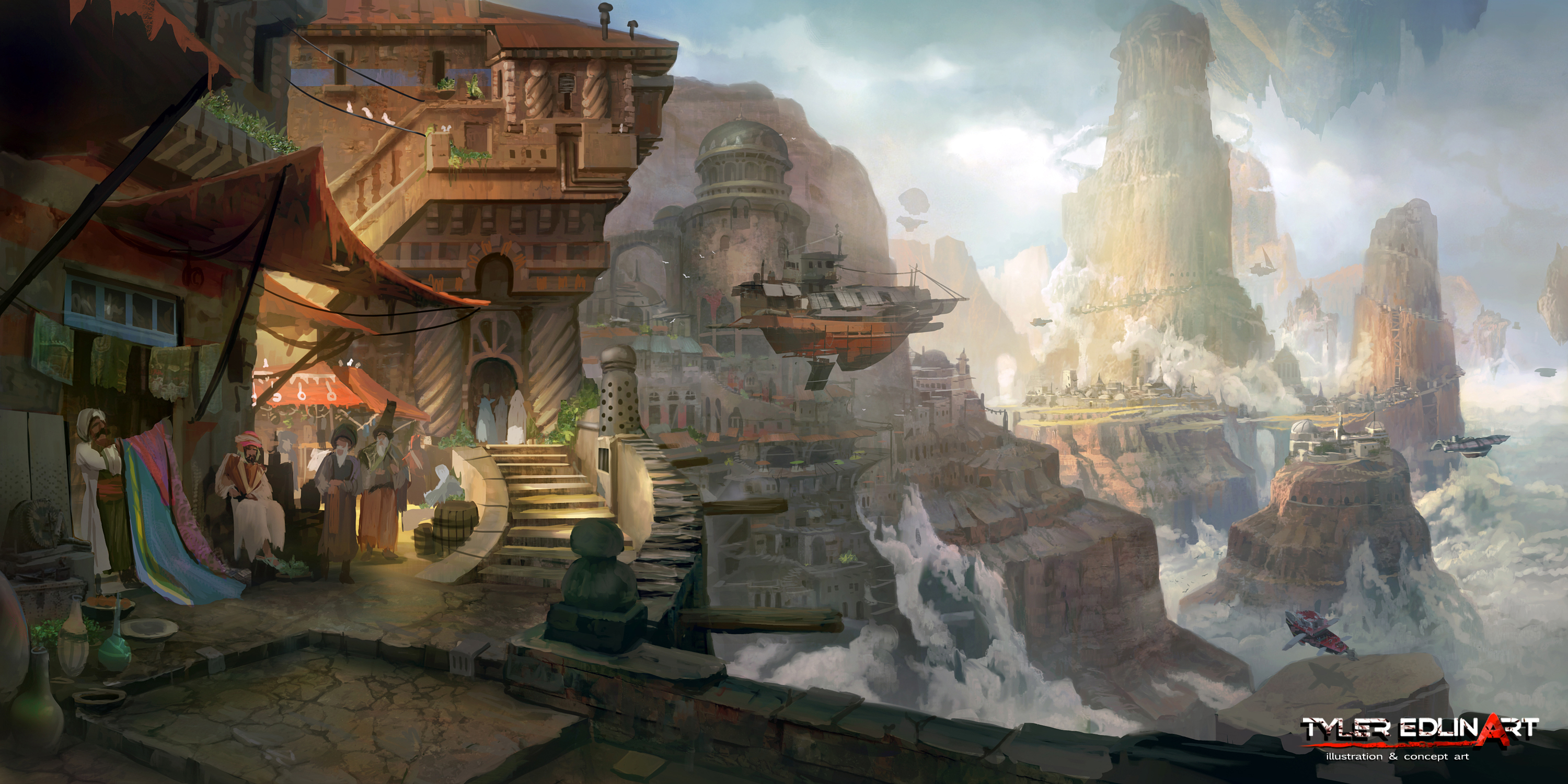
This is an concept artist who worked on Guild wars 2 he has a couple of videos on YouTube showing a real time recording of him painting a piece including the one below. The genre of this art would be somewhere around the lines of fantasy art and environmental art, allowing the target audience to be of a younger audience along with older. The main audience would be someone interested in game concepts and landscape concepts. The composition of the image shows foreground to background, with the focal point being the miniature market on the left. When looking at the painting my eye is lead to the focal point and then across to the background looking at the waves. The painting asymmetrical and it works that way because if it was symmetrical it would seem less like a fantasy and wouldn't look as adventurous as it does. The main organisational features would be the market and the floating ship along with the characters.
There's an effect of naturalism in the painting when looking at the rocks they seem to be far away by using the illusion of clouds and a depth of field, this is crucial in a concept piece to show what it would look and feel when playing it in a game for example if the player was to stand at the market how far would the rocks be in the game. The colours are well mixed and use a variation of warm and cool colours, the market uses much more warm browns,reds and yellows. The yellow and light brown around the warm colours allows them to shine out more and make a good sense of warmth. The background moves away from warmth and express many light shades of blue to capture the essence of the sky. Near the center there is a large ray of yellow to show light coming from behind the rocks. The blue colour give you a great sense that the market may be near a coast line along with the obvious hint of the sea.
The lighting in the painting is used very well all light is coming from behind the features so the sun could be about to rise or set. The light near the market make me think there is maybe some sort of festival or more market from where the light is coming from because of the intensity of it the amount of people near it, this light is highlighted on the stairs which is given a great contrast between shadows and light allows the painter to mix the colours.The lighting at the back is very simple but effective because of it being from the sky but not the sun itself. So it's very cloudy with some rays of high intensity light passing through and hitting certain areas of the rocks. There is one part of the painting that isn't hit by any light leaving it much darker and in a way divides the two main features (market and rocks/sea).
Gustav Bauernfeind
http://www.artnet.com/artists/gustav-bauernfeind/biography-links
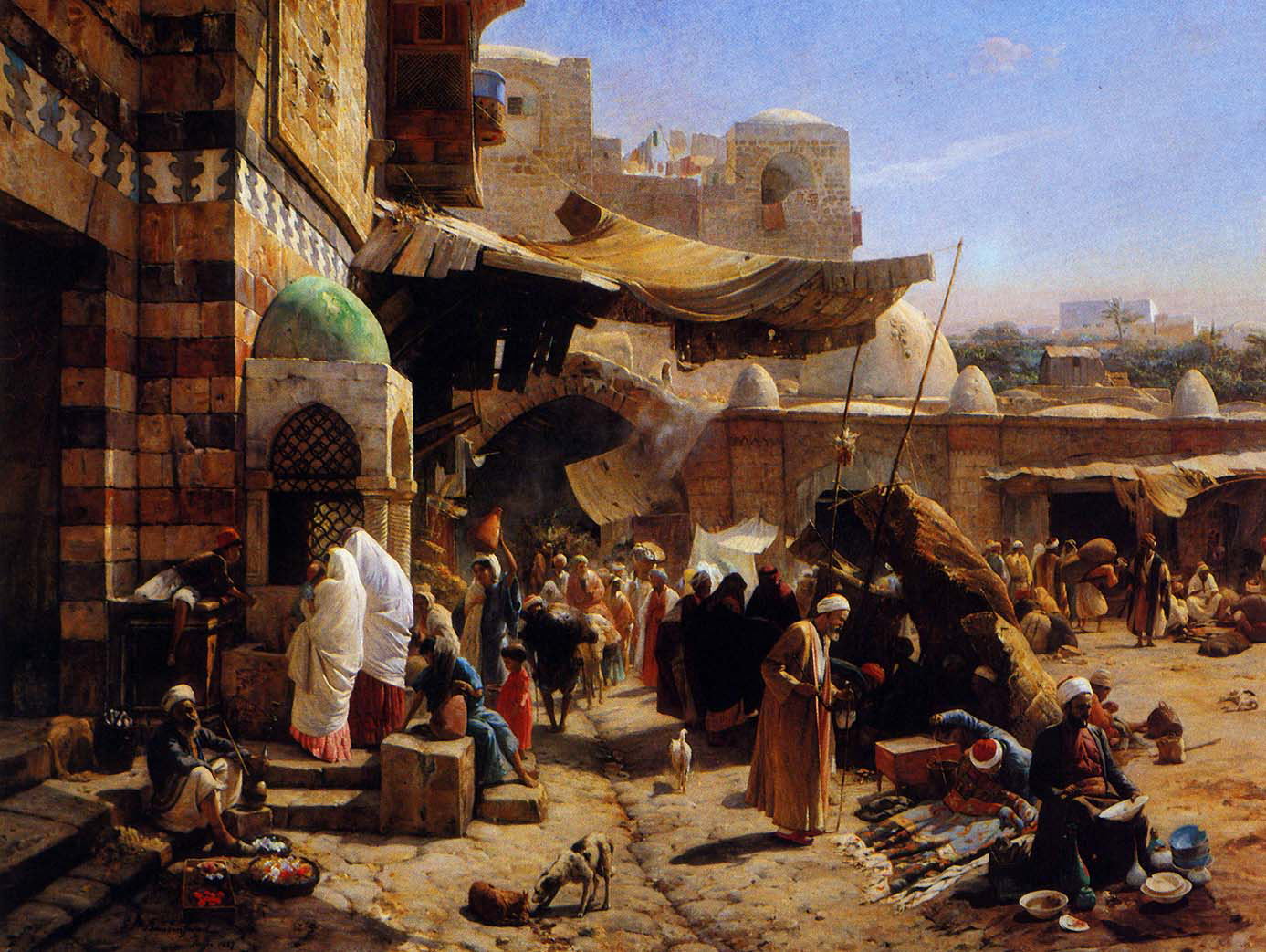
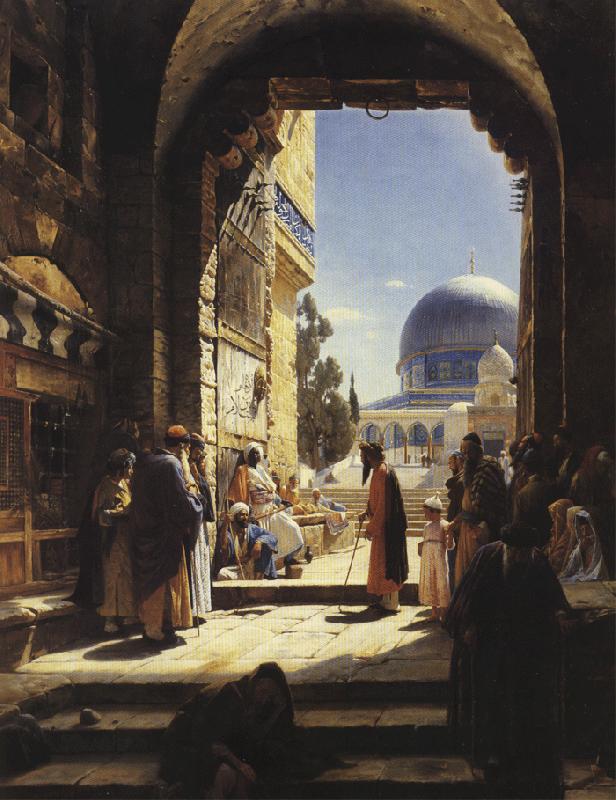
By what ive found from later generations of painting i think Tyler may have been inspired by Gustav Bauernfeind with his market painting from the 1800's. Along with some of his other work. I think he may have thought that the bottom image could have been where the market light is leading to. The reason he started to paint markets and more eastern paintings is because at first he painted more Swiss and Italian paintings but then decided to travel to the Near east in search for more exotic projects which led him to paint these type of paintings. He then returned to Munich (his hometown) but a few years later returned to the east to live out the rest of his life.


James Clyne
James Clyne is a famous concept artist who has worked for many famous movies such as; Transformers,Avatar,minority report, Sucker punch etc. He explains in an interview how he goes about creating a piece and answers many questions about what he has enjoyed the most which he says "That one would be of course Avatar. A concept artist's wet dream due to the amount of hardware, world building, and technology that was required in the visual development phase."
This is a link to one of the interviews and this is the other one
He mainly uses Photoshop and likes to firstly draw his concept traditionally then scan it into the computer and finish it with Photoshop. This is good to know because this is also how i like to do concept art.
This is one of my favorite pieces from him, it's a jungle landscape which has a strong style of foliage and older paintings.
Women in Art and Ida Kar - Plymouth museum.
Lady Nancy Astor
"In 1919 Nancy Astor took her seat in the House of Commons as the first woman to serve as an MP. In the 90 years since then, many more women have entered the hallowed walls of the Houses of Parliament, there's even been a woman Prime Minister, following in the footsteps of this remarkable woman. But not many people today know her name or her achievements."
"Nancy was not the first woman to be elected to Parliament. That distinction belongs to Constance Markiewicz, who along with the other members of the Sinn Fein party refused to take the oath. If she had, she would have been the first woman to actually take her seat. Her husband, Waldorf had been elected to Parliament from Plymouth and was well on his way to a brilliant career when his father shocked the couple by accepting a peerage, making him Viscount Astor. When his father died, Waldorf succeeded to the title, which meant that he was kicked upstairs to the House of Lords. The seat was now vacant, and it was decided that Nancy would run in the next election to take his place. Nancy took to the British method of politicking like a duck to water. Her quick wit meant that she could deal with the hecklers without losing her ladylike demeanor. Nancy won her seat by more than 5,000 votes over the other candidates."
"Nancy died on May 2, 1964 just before her 85th birthday. She was cremated and her ashes reside with Waldorf’s at Cliveden in an 18th century Octagon Temple, just below the great lawn. A confederate flag was buried with her. Her son Bobby passed away 6 years later in 1970 from an overdose; he is buried in the temple alongside his mother."
This was one of the main painting within the exhibition, because of its size and the story behind it. The painting is very high quality and extremely realistic for its time (1920's). The painting was done by a man called Charles Sims. The painting shows the agreement of the first ever female getting accepted to be a British MP. The woman name is as you could tell Nancy Astor and is from Plymouth which i believe the reason why Astor park was named after her. This is a large statement about equal right towards women and in the exhibition it shows the change in the way women where presented in paintings. The painting itself has one strong focal point which is the the woman (Nancy) and the two men beside her. They are well proportioned and the colours used for the clothing and skin is magnificent.
There is a sense of symmetry if u consider the two men either side of Nancy and then Nancy splits them do up to in a way shine though and the more importance of the piece. After looking extensively at the three people you start to draw closer to the group of men behind them. They are less detailed and seem to be in a much darker area and lighting seems to be coming from the front of the focal point and shows a feel of depth in the painting.
The colours are mainly dark grainy colours and don't really appeal to you but you appreciate it for what it is because you realise that it's a painting of an event not imagination. And people wear very formal clothing in Parliament which can be dull and boring with many shades of brown and green to compensate for it being a house of Parliament. So the range of the palette couldn't of been big and would in a way make it simpler to do. The lighting is atmospheric in my opinion it makes me think of a dark dusty room with no much ventilation.
Ida Kar
"Russian-born, of Armenian heritage, Ida Kar (1908–74) was instrumental in encouraging the acceptance of photography as a fine art. Her subjects were the most celebrated figures from the literary and artistic spheres of 1950s and 1960s Europe and Russia. They include artists such as Henry Moore, George Braque, Gino Severini and Bridget Riley and writers such as Iris Murdoch and Jean-Paul Sartre."
Ida Kar was famous for producing fantastic photos with Roloflex camera in the 1940's. This was extremely hard back them because one you would take the picture from your waist and two you couldn't look at what was just taken so you had to know what you were doing. The camera itself reminded me a the Steam punk theme with all the lenses and shape and design of it along the mechanical/chemical process. The risk of taking pictures with these cameras was very high as it was expensive for film, but if it came out great in the end i expect that it would've been a great achievement.
Specialist investigation
Matt Cioffi
This is a famous 3D modeler and sculptor mainly sculpting and has worked on "star wars the clone wars". An interview with him that pixologic did allow me to get an insight on his work. Hes been drawing ever since he was young. He has a BFA in media and performing arts from Massachusetts College of Art. And his focus was experimental animation and independent studies with the computer department. He enjoyed drawn animation wit photographed cells and directly on the film itself, also composing and recording electronic music. He made his first 3D CG character animation in 1996/97 using lighttwave3d, midi software,premiere, and a dual Pentium II for senior project. After college he did some freelance work doing multimedia and 3d animation before he took a full time job at a small robotics company which later became iRobot, makers of the Roomba robotic floorvac. He did everything from concept visualization,interactive toy design,industrial,to web development. In his spare time he worked on his own CG character modeling and animation techniques which became his main passion.
From this interview i was also able to find out how he gets such great detail in his final renders.
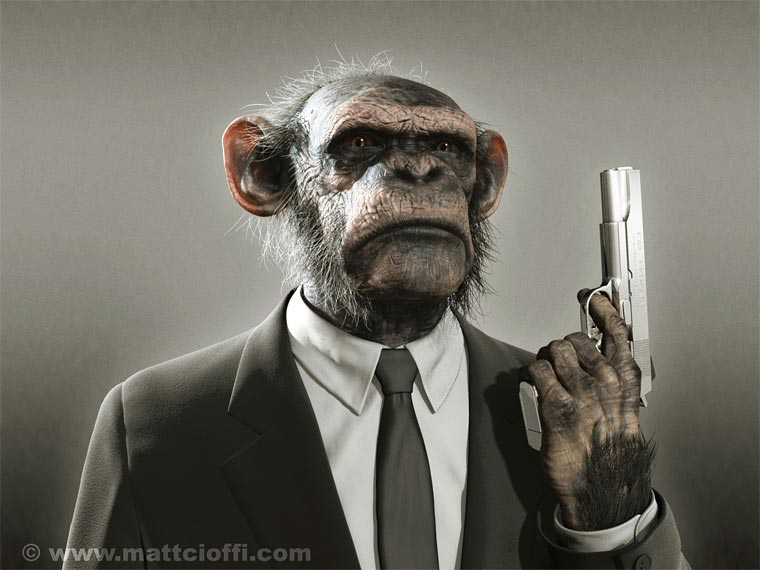
"Thanks. Getting nice natural wrinkles starts with having the underlying geometry flowing nicely. I spend a lot of time upfront laying out the edgeloop flow and working the geometry on the first few subdivision jumping up and down the levels in ZBrush before adding lots of detail. Check out the close-up of Joe-Fixit’s face: notice that the edgeloops for the most part follow the patterns of both the musculature and the wrinkles. I tend to work on the ZBrush sculpt up to the medium - high frequency detail, then I start to layer maps that are either painted in 2d, 2.5d, 3d, or generated procedurally with Brownian and noise maps etc. I like to break up the finer details so that I can tune them separately."
This work astonishes me because the amount of detail put into this model, it makes me want to work on something like this myself. The lighting in this image aswell is very nicely done and help complement the fur on his neck and at the back of his head giving him a inner glow effect. I also liked the model of the pistol which would of been sepreatly made in another 3D software and then imported in and having that blend in with the other model can be very hard work so that another accomplishment he has done withing this render.
How is he different from other sculptors in Zbrush?
Even though there are many other Zbrush sculptors Matt Cioffi stands out to me for one of the reasons his was one of the first sculpts i saw so straight away that put my idea of quality in Zbrush much higher, and second this piece is iconic in the 3d industry and has always been one of those pieces people look back at and still are amazed at the work even though its starting to be a little outdated. More and more people are starting to use Zbrush nowadays which has set the quality of work a lot higher now and harder to stand out from the rest for example Christopher Brändström is a Zbrush sculptor who not to long ago did a noire flash character model which again stood out from the rest because of the quality and the fact that everyone knew who flash from DC was. But many others do some original piece and it wont get noticed as much unless the quality is phenomenal.
Nick Mackman
"Nick Mackman is a sculptor of one-off clay animals. Drawing on her experience as a rhino keeper and on safari, she aims to get under the skin of the animal and then recreate it, giving each one its own personality. Her pieces are Raku fired, giving a rich but natural crackle glaze. Sometimes bristles, papier maché and other materials are used.
Some of her subjects are relatively unknown or highly endangered and she has travelled to places such as Botswana and Madagascar to observe many of the animals she models in the wild. It is with these animals that she aims to enlighten us to their beauty, humour and tenderness, even though they may be largely perceived as purely ugly or aggressive.
She has been widely exhibited and over the years her animals have found homes with, amongst others, John Cleese, June Whitfield and Viscountess Serena Linley. She has accepted commissions from British Airways and the Wildlife Photographer of the Year competition, making trophies for the award winners."
http://www.beauxartsbath.co.uk/Mackman/Pages/Index.html
Personally i love this work as it shows a different style in the traditional sculpts you see so often (bronze sculpts). The way she shows actual definition in the fur and skin even though it doesn't look much like fur the indents and creases makes you understand what she is trying to achieve in her work.
Comparison
The two chimps are both produced completely differently but neither misunderstand the anatomy of the chimp. The zbrush model is much more realistic with high res fur and wrinkles. But Nick Mackmans' is a lot more handmade and solid for the fact she doesn't add any fur to her models, where as Matt can easily do that in zbrush and other softwares on the computer. This shows the difference in styles that can be achieved wit either making them hand made or on a computer.

Auguste Rodin
Bio
"Auguste Rodin, born in Paris on November 12, 1840, was a famous sculptor known for creating "The Age of Bronze," "The Gates of Hell" and "The Burghers of Calais," among several other works. Unlike many famous artists, Rodin didn't establish his distinct artistic style or a credible list of works until he was in his 40s."
Work
"After working as a bricklayer for nearly two decades, in the late 1870s, Rodin made a bold decision to embark once again on an artistic career. A fateful trip to Italy had stirred Rodin's inner-artist, enlightening him to new kinds of art and career possibilities; he returned to Paris inspired to design and create, specifically to sculpt.
"Rodin soon completed his first piece, "The Vanquished" (later renamed "The Age of Bronze"), a sculpture of a nude man clenching his both of his fists, with his right hand hanging over his head."
"A depiction of suffering amidst hope for the future, the work was first exhibited in 1878, when Rodin was in his late 30s. While "The Age of Bronze" earned Rodin some recognition as a sculptor, he remained a relative unknown until a few years later, in the early 1880s—when Rodin, in his early 40s, first established both his distinct artistic style and a credible list of works.
Rodin went on to create several other famous works, including "The Burghers of Calais," a public monument made of bronze portraying a moment during the Hundred Years' War between France and England, in 1347. The piece, which includes six human statues, depicts a war account that Rodin had researched, during which six French citizens from the town of Calais were ordered by King Edward III of England to abandon Calais and surrender themselves—barefoot and bareheaded, wearing ropes around their necks and holding the keys to the town and the caste in their hands—to the king, who ordered their execution thereafter. "The Burghers of Calais" is a portrayal of the moment that the citizens exited Calais. Rodin began working on the monument in 1884, after being commissioned by the town of Calais to create it. However, the piece wasn't unveiled in the town until more than a decade later, in 1895."
Death/Legacy
Auguste Rodin died on November 17th 1917, before finishing a piece he was working on called "The Gates Of Hell"
"Garnering acclaim for more than a century, Rodin is widely regarded as the pioneer of modern sculpture. His work continues to be studied and deeply admired by fellow artists, experts, scholars and art connoisseurs, as well as those with an untrained eye."
Personally his work was basically one of the ones that started it all the detail and the correct proportions in anatomy stunned the world each time a new sculpt was released. The way he would define the muscles and bone structure on a human sculpt was remarkable and show effort and time put in to all these model. From researching Auguste Rodin i want to try a traditional sculpt for myself to understand better how difficult it must be or not be to get this perfect.
Books
Anatomy book - Christopher Hart
I chose this book because i knew that i wanted to find something that would help me improve my overall drawings and help me have a better insight of character design, this would also help towards improving my work and portfolio for uni. The book starts by teaching you the features of the face and good methods to draw them, then it goes into detail about the bone structure of the human body and the muscles in the body and how to draw them. What i personally found most interesting was the diagram of where to shade so the muscles can be defined realistically. This book is very helpful for learning the anatomy and understanding different perspectives of it. I have done a drawing of one of the tutorials in the book teaching you how to draw a correct sized head with symmetrical facial features.
Rodin - Phaidon
I chose this book because i wanted to look more into the past of Auguste Rodin and how he came into the work of sculpting. Whilst reading through this book it shows how before sculpting he painted a lot of erotic art which helped him understand anatomy and then went on to sculpting his first project called "The Kiss" made out of marble. The then goes on to talk about personal life and how he traveled to Italy for two months to study the work of Donatello and Michelangelo which took him into the age of bronze. This book showed how you must go a see the world and understand different styles and cultures and see what you like the most to understand your own style.